

Kalshi lets users trade on the outcome of real-world events, including sports, elections, economics, crypto, weather and entertainment. It looks increasingly similar to a betting app in some areas, but Kalshi is not structured as a conventional sportsbook. It operates as a federally regulated prediction market exchange where users trade event contracts with each other.
For sports fans, that distinction matters. Instead of a sportsbook setting fixed odds and taking the other side of your bet, Kalshi uses an order book. Contract prices change as traders buy and sell, and a contract that settles correctly is generally worth $1.
Kalshi is regulated by the Commodity Futures Trading Commission (CFTC) as a Designated Contract Market. However, its sports markets are also at the center of an ongoing dispute over whether states can apply their own sports betting and gambling laws. That means availability should be checked before trading rather than assuming every Kalshi market is available everywhere in the US.
| Kalshi | Details |
|---|---|
| Kalshi Promo Code | Referral/partner code varies |
| New Customer Bonus | Referral reward varies by current promotion |
| Minimum Deposit | $10 |
| Platform Type | CFTC-regulated prediction market exchange |
| Sports Markets | NFL, college football, NBA, WNBA, MLB, NHL, soccer, tennis, golf, MMA, esports and more |
| How It Works | Trade event contracts based on real-world outcomes; winning contracts are worth $1 |
| Trading Fees | Variable by contract price and market; fees are generally highest around 50¢ contracts |
| Maker Fees | Some markets charge lower maker fees for resting orders that later execute |
| Funding Methods | ACH, debit card, Apple Pay, Google Pay, PayPal, Venmo, Cash App, crypto and wire transfer |
| Minimum Age | 18+ |
| Interest on Eligible Balances | 3.25% variable APY for qualifying accounts |
| Demo Account | Yes |
| Best For | Sports prediction markets, broad event coverage and active trading |
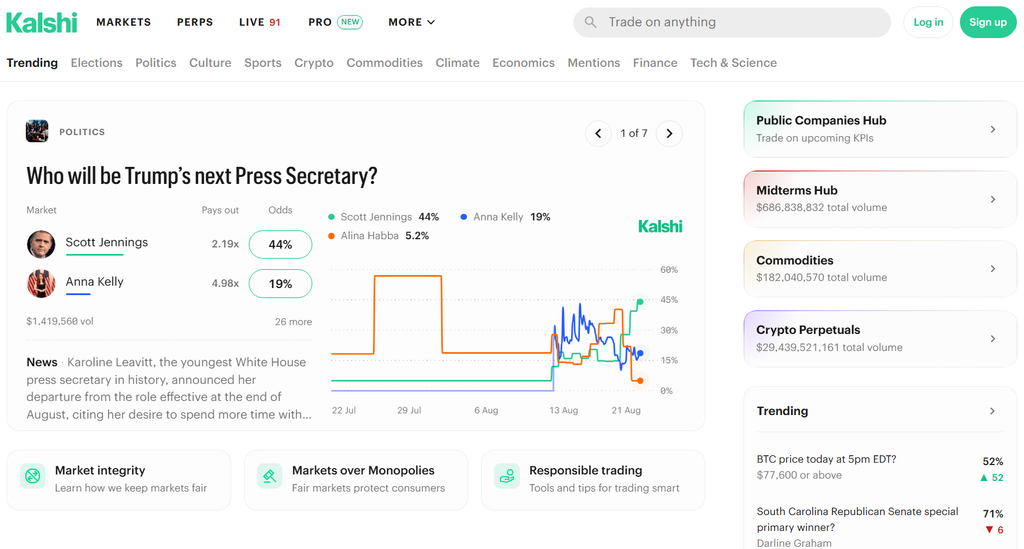
Kalshi Promo Code and New Customer Offer
Kalshi does not currently publish one permanent nationwide welcome bonus with a fixed promo code in the way many sportsbooks do.
Instead, Kalshi operates referral and partner promotions, and the reward can change. Kalshi says the current bonus amount and qualifying trading requirement are displayed in the user’s Rewards section.
A referral code can be entered during signup. In some cases it can also be added for up to 72 hours after opening the account, provided the customer has not already made a first deposit.
Referral credits are normally intended for trading rather than direct withdrawal. Profits generated from the credit can be withdrawn, while the original promotional credit generally cannot. Kalshi says referral credits normally expire after 30 days unless different terms are stated.
This is an area where customers should check the exact offer displayed when joining rather than relying on an old Kalshi promo code found online.
What Is Kalshi?
Kalshi is best understood as an exchange for event contracts.
Each market asks a question about a future event. A simple example could be:
Will Team A win tonight?
If a Yes contract trades at 60 cents, the market is effectively pricing the outcome at around a 60% probability. A No contract will trade around the opposite side of the market.
If you buy Yes at $0.60 and the market ultimately resolves Yes, the contract pays $1. Your gross gain is therefore $0.40 per contract before trading fees.
If the event resolves No, the Yes contract becomes worth $0.
Prices aren’t set permanently by Kalshi. Buyers and sellers submit orders, and the resulting market determines the price.
That also means Kalshi prices should not be treated as guaranteed probabilities. They reflect the prices available from traders in that market at that moment.
Kalshi Sports Prediction Markets
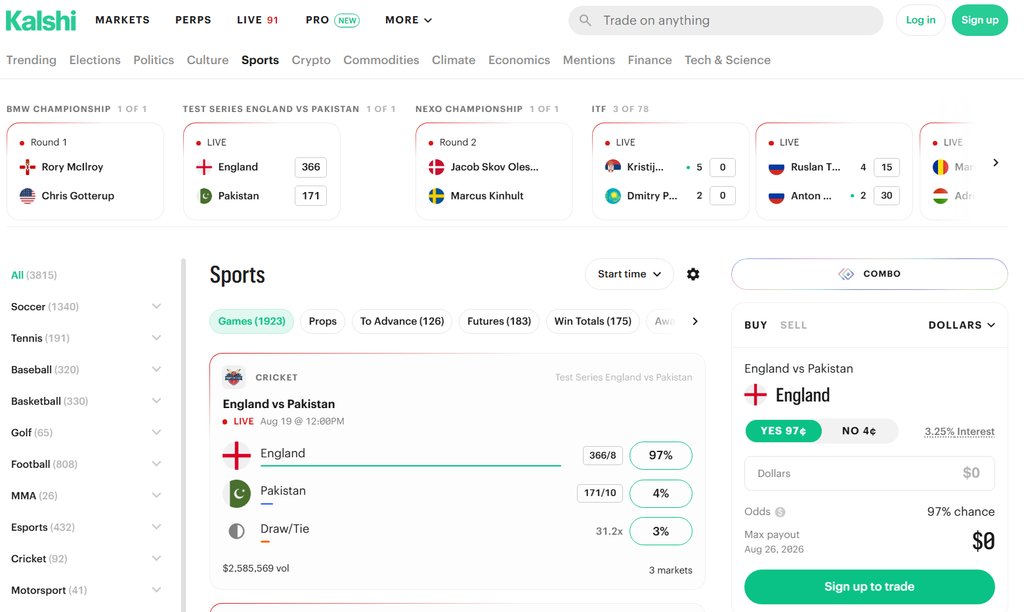
Sports has become one of the largest parts of Kalshi.
Current markets cover leagues and events across football, basketball, baseball, tennis, golf, soccer, cricket and other sports, with markets ranging from individual games to season futures and championship outcomes.
Depending on the sport and event, customers may find familiar concepts such as:
Game winners, spreads, totals, championship winners, division winners, season win totals, tournament advancement and player-related markets.
There are also Combos, Kalshi’s version of combining several outcomes into one position.
Combos are technically separate event markets rather than conventional sportsbook parlays. Pricing is obtained through a Request for Quote system, and every component generally needs to settle successfully for the combo to pay its full $1 contract value.
That distinction may sound technical, but it matters. Kalshi’s sports product increasingly resembles online sports betting from a user perspective while the underlying product remains a derivatives exchange.
Is Kalshi Legal and Regulated?
Kalshi is a CFTC-regulated Designated Contract Market. Its DCM designation dates to November 2020, and it began offering event contracts afterward.
That does not, however, make the legal position of every Kalshi sports contract simple.
Kalshi’s position has been that its event contracts are federally regulated derivatives and therefore fall primarily under federal commodities law.
Several state gaming regulators disagree. They argue that contracts based on sports results amount to sports wagering and must comply with state gambling laws and licensing requirements.
This disagreement has produced significant litigation.
In 2026, courts in Massachusetts, Nevada, New York, Michigan and Washington have issued decisions or orders restricting Kalshi’s sports-event activity or allowing state gambling enforcement to proceed. Washington’s August 2026 order went further and required Kalshi to restrict several other types of prediction markets in the state as well.
Other courts have reached different conclusions. For example, Kalshi has won favorable rulings concerning federal preemption in other jurisdictions, so the legal question is not settled nationally.
For bettors, the practical point is simple: don’t interpret “CFTC regulated” as meaning every sports market is automatically available in every state.
This is also why we would not publish a static list claiming Kalshi is legal in all 50 states. State availability is changing too quickly.
How Kalshi Fees Work Compared to Sportsbooks
Kalshi does not make money through a traditional sportsbook margin. The exchange charges transaction fees.
Its standard taker-fee formula is:
0.07 × number of contracts × price × (1 − price)
Fees therefore change according to the price of the contract. They are highest around the middle of the market and lower when an outcome trades close to $0 or $1.
For example, buying 10 contracts at 50 cents produces a standard transaction fee of approximately $0.18.
You would spend $5 on the contracts plus the applicable fee. If those contracts ultimately settle at $1 each, they pay $10.
Some markets use different fee schedules, and Kalshi tells customers to check the fee shown in the order panel before confirming a trade.
Maker vs. Taker Fees
An important feature for more experienced traders is the difference between maker and taker orders.
A taker accepts liquidity already available in the order book and trades immediately.
A maker places an order at a chosen price and waits for someone else to accept it.
Some Kalshi markets charge maker fees as well, although these are generally lower than standard taker fees. Kalshi’s February 2026 general maker formula uses a 0.0175 multiplier compared with 0.07 for the standard immediate-execution fee.
This is one way Kalshi differs materially from a normal sportsbook: how you place the trade can affect your cost.
Liquidity Matters on Kalshi
Another difference from sportsbook betting is liquidity.
A sportsbook normally accepts an eligible wager directly, subject to its limits. On Kalshi, you need somebody on the other side of your trade.
Popular markets can have substantial trading volume and deep order books. Smaller or more unusual prediction markets may have much less liquidity.
This becomes especially important if you want to exit before settlement.
Kalshi lets traders sell an existing position, but a buyer must be available at an acceptable price. In a thin market, the actual cash-out price can be worse than the displayed portfolio value, or it may not be possible to sell the entire position immediately.
For that reason, market volume, bid-ask spread and order-book depth are worth checking before entering larger positions.
3.25% APY on Eligible Kalshi Balances
One unusual Kalshi feature is interest on eligible balances.
Kalshi currently advertises a 3.25% variable APY for qualifying US customers with at least $250 in eligible portfolio value. Interest accrues daily and is generally paid monthly.
Importantly, the calculation can include both available cash and the value of open qualifying positions.
The rate is variable, so 3.25% should not be treated as guaranteed permanently.
For customers holding longer-term prediction contracts, however, earning interest while capital remains committed is a genuine difference from a standard sportsbook account.
How To Sign Up for Kalshi
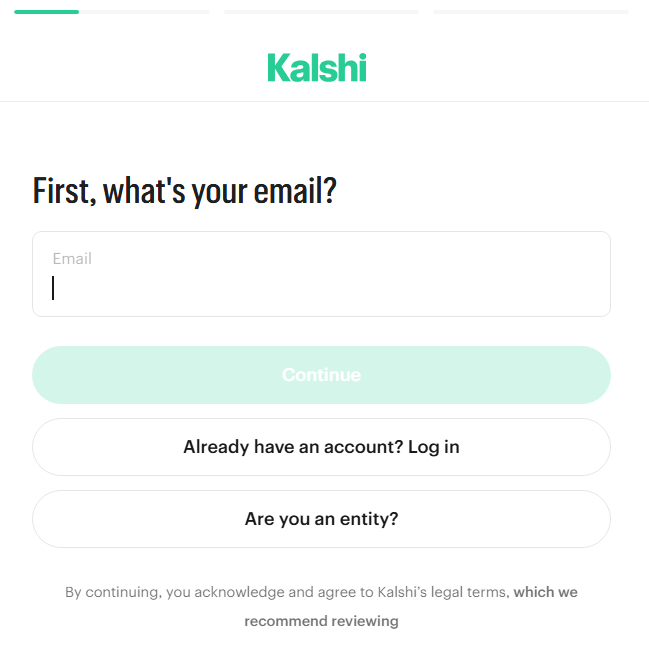
Opening an individual Kalshi account requires customers to be at least 18 years old. Kalshi also carries out identity verification to comply with its regulatory obligations.
The process is relatively straightforward:
- Create a Kalshi account using email, Google or Apple.
- Verify your email address and phone number.
- Provide the requested personal information.
- Complete identity/document verification if required.
- Enter an eligible referral or partner code before depositing.
- Deposit funds and select a market to begin trading.
Kalshi requires both email and phone verification and may request additional documentation as part of KYC checks.
There is also an official Kalshi demo environment that allows users to explore trading with mock funds before risking real money.
Kalshi Deposit and Withdrawal Methods
Kalshi supports considerably more payment methods than many trading platforms.
| Method | Deposit | Withdrawal |
|---|---|---|
| ACH Bank Transfer | Yes | Yes |
| Debit Card | Yes | Yes |
| Apple Pay / Google Pay | Yes | Via eligible card |
| PayPal | Yes | Yes |
| Venmo | Yes | Yes |
| Cash App | Deposit only | No |
| Cryptocurrency | Yes | Yes |
| Wire Transfer | Yes | Yes |
The normal minimum deposit is $10, while wire transfers have a $1,000 minimum.
ACH deposits have no Kalshi processing fee. Debit deposits may carry a 2% processing fee, which makes ACH the more economical option for many US customers.
ACH deposits generally settle within five business days, although Kalshi may make part of the balance available earlier.
Withdrawals by ACH are free and normally reach the bank within several business days. Debit-card withdrawals are also free from Kalshi and can arrive within hours, although individual banks and payment processors can delay them.
Recently deposited funds can be subject to security holds. Trading profits above the deposited principal are not subject to those same deposit holds.
What Can You Trade on Kalshi?
Sports is only part of Kalshi.
The exchange currently lists markets covering areas such as politics, economics, financial markets, crypto, climate and weather, technology, entertainment and culture alongside sports.
That variety is one of Kalshi’s strongest differentiators.
A customer could potentially trade an NFL result, a Federal Reserve decision, an inflation reading, a cryptocurrency price threshold and an entertainment outcome from the same account.
Every market has its own settlement criteria and designated information source. Traders should read these rules rather than assuming the wording of the headline alone determines the result.
Kalshi says determination can sometimes take from around an hour to more than 12 hours after a market closes, depending on when the specified source publishes the required data.
Kalshi Customer Support
Kalshi recommends contacting support through its in-account support messenger, which allows support staff to access relevant account information more easily.
Email support is available as a backup for customers unable to use the chat system.
Kalshi currently does not offer telephone or text-message customer support.
Responsible Trading Tools
Kalshi trading involves real financial risk. A losing event contract can become worthless, meaning the trader can lose the full amount paid for the position plus applicable fees.
Kalshi has expanded its responsible-risk tools during 2026. Customers can set controls including personalized funding limits, and Kalshi also provides longer-term responsible trading restrictions. Once certain restrictions are activated, they cannot simply be reversed before their selected period expires.
This is particularly relevant as the distinction between financial trading and gambling becomes less obvious on sports and entertainment markets.
Kalshi FAQs
Is Kalshi a sportsbook?
No. Kalshi is a CFTC-regulated prediction market exchange. Users trade event contracts against other market participants rather than placing conventional bets directly against a sportsbook. Its sports markets can nevertheless look and behave similarly to sports betting products.
What is the Kalshi promo code?
Kalshi uses changing referral and partner promotions rather than one permanent public promo code. The bonus amount and required trading activity can vary. A referral code generally needs to be entered before the first deposit and can in some cases be added within 72 hours of signup.
How much does a Kalshi contract pay?
A standard successful binary event contract generally settles at $1, while an unsuccessful contract settles at $0. The amount you profit depends on the price you paid and applicable fees.
Can I cash out a Kalshi trade early?
Yes, if there is sufficient liquidity. You can sell contracts before the event settles, but the price depends on buyers available in the order book. A low-liquidity market may be harder or more expensive to exit.
Is Kalshi legal in every US state?
Kalshi is federally regulated by the CFTC, but the availability of specific event contracts — particularly sports markets — is being challenged by multiple states. Court orders have already restricted Kalshi activity in several jurisdictions during 2026. Customers should check current availability from their location.
How old do you need to be to use Kalshi?
Kalshi requires individual account holders to be at least 18 years old and to complete its identity-verification requirements.
Does Kalshi charge deposit fees?
ACH bank deposits are free. Debit-card deposits may carry a 2% processing fee. Fees for other methods can depend on the payment provider or transfer method.
Is Kalshi Worth Using?
Kalshi is considerably more interesting than simply calling it another way to bet on sports.
For sports users, the ability to trade game outcomes, futures and combinations is familiar, but the exchange model changes the economics. Prices come from other market participants, liquidity matters, positions can be traded before settlement and fees depend partly on how and where an order is executed.
The wider prediction-market catalog is arguably its biggest advantage. Kalshi lets customers trade outcomes that traditional sportsbooks generally do not cover, ranging from economic data and weather to technology and entertainment.
There are drawbacks.
The fee system takes more effort to understand than sportsbook odds, less-liquid markets can be difficult to exit efficiently, and the state-by-state legal position of sports prediction markets remains unsettled in 2026.
For users who understand those differences, Kalshi offers something genuinely distinct from a conventional sportsbook. For someone who simply wants to place a straightforward moneyline bet and forget about order books, liquidity and transaction fees, a licensed state sportsbook may remain easier to use.